
Parenting a child with Angelman syndrome requires constant vigilance
But all that watching has taught us to really see our son
Written by |

There are some things I never expected would become a normal part of parenting.
One of the first questions I ask someone who’s been looking after Jude, our 3-year-old son who lives with Angelman syndrome, for an extended period isn’t always, “How was his day?” Sometimes it’s, “Did he do a poo?”
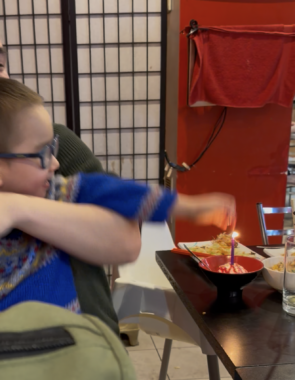
The hands. Always watch the hands. (Courtesy of Joelene Wand)
Constipation is an ongoing battle, so knowing when Jude last went to the toilet and having an almost encyclopedic familiarity with the Bristol stool chart is now a key part of our parenting skill set.
Having a meal with Jude involves preparation, too. First, we clear everything within a 1-meter (3-foot) radius of his seat: plates, cutlery, cups, salt and pepper shakers — anything within reach is likely to be tipped, pulled, chewed, or somehow end up on the floor.
And we’ve developed extremely fast reflexes. Catching the falling spoon. Saving the dog’s tail. Stopping the hand from reaching for our hair, glasses, or, recently, candles.

Tell me you’re an Angelman parent without telling me you’re an Angelman parent.
We have “safe spaces” in our house, somewhere we can safely leave Jude if we’re alone and need to prepare dinner, put the washing on, or go to the toilet.
The phrases “Not for eating” and “No biting” get way too much airtime in our household. We go through an impressive number of replacement straws for Jude’s water bottle, thanks to his habit of chewing holes through them. We interrupt conversations to pull something out of Jude’s mouth that we’re not entirely sure we can identify. And we don’t bother putting his shoes or socks on in the car until we’ve reached our destination, knowing they will inevitably end up in his mouth.
Sometimes parenting Jude feels like choosing between two equally questionable options. Do I keep his glasses on in the car, knowing there’s a good chance he’ll pull them off and start chewing the lenses, or take them off and hope he can still enjoy looking out the window? Do I spend an entire train trip redirecting Jude’s hands away from strangers’ coats, bags, and legs, or decide that letting him lick and chew his own toys so his hands are occupied is the lesser evil?
You pick your battles.
Drool is common, so carrying spare shirts is just part of everyday life. So is doing several loads of wash each week and regularly reassuring people, “No, he’s not teething.”
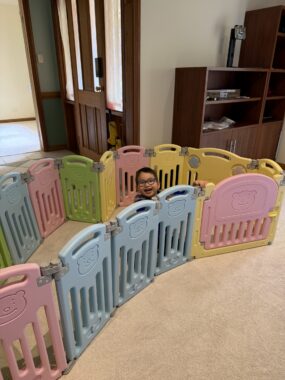
Joelene Wand creates a safe space where her son, Jude, can be alone while she does chores. (Photo by Joelene Wand)
And we can distinguish between different laughs. The giggle at fun and excitement, such as during bath time, can be deafening. But it’s entirely different from the one which tells you, “I have found something I should not have found.”
We become acutely aware of Jude’s baseline — the usual noises, movements, and moods — and, importantly, when something isn’t quite right, like when we discovered he had osteomyelitis. When you spend so much time watching your child, you become exceptionally good at noticing the subtle changes that might otherwise be easy to miss.
That same attentiveness also means noticing the things that might seem insignificant to someone else. Like Jude starting to raise his hand slightly when he sees a familiar face, his own little version of a wave. How happy he is to practice his pincer grasp while snacking on sultanas and Cheerios. These moments might barely register with someone else, but are enormous to us, the people who love him and his hardworking therapists who have helped him get there.
Parenting a child living with Angelman syndrome involves lots of vigilance. Sometimes it can feel like we’re on high alert trying to create a world that keeps Jude safe while also protecting ourselves and anyone else who happens to be within reach. We spend so much time watching Jude, his hands, what he puts in his mouth, or things that could hurt him. But all that watching has also taught us to really see him — to notice when something’s not right, to celebrate the small moments, and to recognize just how much they can mean.
Note: Angelman Syndrome News is strictly a news and information website about the disease. It does not provide medical advice, diagnosis, or treatment. This content is not intended to be a substitute for professional medical advice, diagnosis, or treatment. Always seek the advice of your physician or other qualified health provider with any questions you may have regarding a medical condition. Never disregard professional medical advice or delay in seeking it because of something you have read on this website. The opinions expressed in this column are not those of Angelman Syndrome News or its parent company, Bionews, and are intended to spark discussion about issues pertaining to Angelman syndrome.


Amy Taylor
My 3 year old granddaughter was diagnosed with angelman syndrome and I feel so lost