
Angelman syndrome seizures are unpredictable, but we carry on
Our long-planned family holiday almost didn't happen
Written by |

It was the day before a long weekend, and we were supposed to leave that afternoon for a family road trip we’d planned six months earlier.
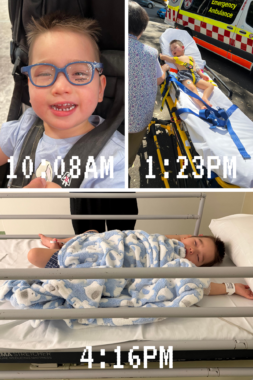
Six hours in Jude’s life in April 2026, clockwise from top left: Jude tries on glasses in the morning, is wheeled away in an ambulance after a seizure, and sleeps in the hospital in the late afternoon. (Courtesy of Joelene Wand)
My husband, Tom, decided to take Jude, our 3-year-old son with Angelman syndrome, out that morning to buy a pair of glasses after learning earlier in the week that he was farsighted. It should have been a small errand before a family holiday. Meanwhile, I finished some last-minute work.
Tom spontaneously invited his mom along, as she loves spending time with Jude, and it was a nice addition to an otherwise routine morning. They picked up Jude’s glasses, had lunch, and drove home to pick up our luggage.
During their drive home, I received a call: “Jude’s thrown up twice in the car and he’s having a seizure,” Tom said. It was a complete surprise to hear that Jude was burning up with a fever, a common seizure trigger, as he’d seemed perfectly well that morning. And Jude hadn’t had a seizure since he started seizure medication about 10 months earlier.
In the moment, you don’t always do the things you know you should do. There was no video recording of the seizure, which lasted four minutes. Video footage is crucial for doctors to guide care, but when a seizure occurs, your instinct isn’t to reach for your phone.
There were also moments of quiet luck that we never could have planned for.

We will never know how long Jude’s seizure might have lasted if Tom had been driving alone. If Tom hadn’t happened to drive past a group of paramedics on their lunch break, help might not have arrived so quickly. And if I hadn’t absentmindedly packed Jude’s seizure medication in our “going out” bag the night before in preparation for our trip, we would have been caught without it when we unexpectedly found ourselves at the hospital.
By the time I arrived at the hospital in mid-afternoon, the chaos had settled. Jude’s neurologist recommended an increase in his medication, and he was discharged by dinnertime. Jude was slightly subdued but mostly his usual, cheerful self.
What now?
Then came the questions we hadn’t expected to face earlier that day: Do we still go on our holiday? Is it safe to do so? Would it be irresponsible if we did?
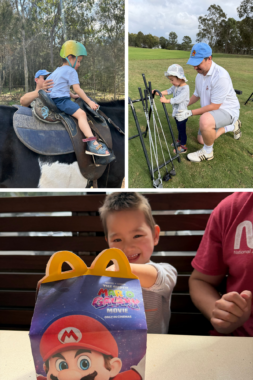
Small moments from our road trip in April 2026, clockwise from top left: Jude’s first pony ride, time with Dad, and a very special first Happy Meal. (Courtesy of Joelene Wand)
We were advised that if Jude was well the following morning, there was no reason we couldn’t travel as planned. And by the following morning, Jude seemed back to his usual self.
We chose to still go on our trip, knowing that while it felt manageable this time, the next time it may not. Living with and caring for someone with Angelman syndrome means uncertainty will always be part of our lives. Seizures may happen, and plans may change. But if we wait for everything to be perfectly stable and predictable, we may never go at all.
We prepared as best we could. We brought more medication than we thought we’d need, checked which hospitals were near our accommodation, packed Jude’s hospital discharge summary just in case, and planned for a slower-paced holiday.
Because on the other side of the decision to go were the moments that matter most to us: family time away from the medical appointments and the weight of “what could have happened.” Jude went on his first pony ride, joined his dad at the driving range, and had his first taste of his parents’ long-standing tradition of McDonald’s on road trips.
This holiday almost didn’t happen, but in the end, it did. We carry on as fully as we can, even with the unpredictability seizures may bring.
Note: Angelman Syndrome News is strictly a news and information website about the disease. It does not provide medical advice, diagnosis, or treatment. This content is not intended to be a substitute for professional medical advice, diagnosis, or treatment. Always seek the advice of your physician or other qualified health provider with any questions you may have regarding a medical condition. Never disregard professional medical advice or delay in seeking it because of something you have read on this website. The opinions expressed in this column are not those of Angelman Syndrome News or its parent company, Bionews, and are intended to spark discussion about issues pertaining to Angelman syndrome.


Jorge
Hello!
I’m the father of a 12-year-old boy with AS, and during his first years we had many seizure episodes.
During one of those episodes, the doctor who treated us in the emergency department prescribed Clobazam twice a day, in addition to the Valproate he was already taking.
Thankfully, since that day my son has never had seizures again.
Talk to your paediatric neurologist and ask whether this combination of Valproate + Clobazam could be worth trying. For us, it changed our lives.
Hugs from Portugal and wishing you all the best.
Shoaib
Our daughter Hadia when she was a child, she used to have febrile convulsions/seizures of few seconds to minutes, following throat infection causing high fever and it was recurrent. After using Topamax, she remained seizure-free for five years and later she started having NEM, an episode of which, lasts from 3 to 5 hours. Our kids suffer and we feel helpless seeing them in pain, as mostly the rescue medicines do not provide greater relief. However, despite all the odds, we try to ensure that Hadia enjoys life to the maximum. Our AS kids are full of life and pleasure spirit. She enjoys interacting with people, traveling, having car rides and dining in Malls where people are around her. She does not like standalone restaurants.