
Our nonverbal son’s hospitalization taught us some important lessons
Caring for a child with Angelman syndrome brings a unique set of challenges
Written by |

It’s the middle of winter here in Australia. Runny noses, coughs, and viruses have made their way through households across the country, and ours was no exception.
So it wasn’t a surprise when our 3-year-old son, Jude, who lives with Angelman syndrome, recently developed a fever and had a seizure. Fever is a common seizure trigger for Jude, so while it’s never easy, we knew this was a possibility. It’s what happened afterward that worried us.
Jude usually returns to his baseline self within a couple of hours after a seizure, but this time was different. Whenever his right leg was touched, he grimaced, tensed, and vocalized in a way we’d never heard before. When the pain and fevers continued into the next day, we went to the hospital emergency department on the advice of staff at our Angelman syndrome clinic.
Four days and three nights later, and after blood tests, nasal swabs, X-rays, ultrasounds, a bone scan under sedation, and plenty of waiting, we finally had an answer: Jude had osteomyelitis, a bone infection in his right shin. He was discharged and given a month-long course of antibiotics.

Finding answers is never straightforward
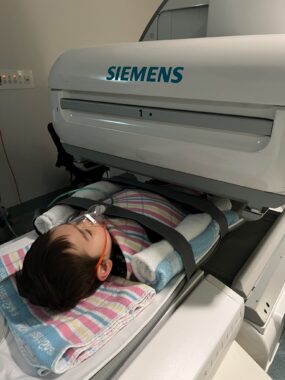
Joelene Wand’s son, Jude, undergoes a bone scan that discovered osteomyelitis in his right shin. (Photo by Thomas Wand)
While a hospital admission wasn’t what we expected, we left feeling incredibly fortunate. Jude is nonverbal and can’t yet explain what might be troubling him, so finding answers is never straightforward. We’d experienced that before, when he was discharged from the hospital with unexplained arm pain, only for us to discover over a week later that he’d fractured his arm. This time, we were lucky the infection had been identified early.
The first lesson we learned was to trust our instincts.
Like many parents of children living with Angelman syndrome, we’ve become experts in noticing tiny changes. We couldn’t explain what was bothering Jude, but we knew he wasn’t himself. He kept his right knee bent whenever we picked him up. He became upset when we put a sock on his right foot. They were subtle clues, but they told us something wasn’t right.
But that didn’t stop us questioning ourselves or wondering if we were wasting everyone’s time. Were his muscles just sore after the seizure? Were his aches simply part of a viral illness? Finding the bone infection reminded us that it’s OK to listen to the little voice telling you something isn’t adding up.
The second lesson was that hospitalizations bring a unique set of challenges when you’re caring for a child with Angelman syndrome.
We spent our days stopping Jude from biting hospital equipment, pulling at his cannula, and pressing the assistance button while sitting on the toilet. Despite our best efforts, he managed to chew on an alcohol swab left within reach.
We also didn’t have all of Jude’s equipment, such as a chair with sufficient postural support, so we had to be constantly vigilant in ensuring his safety.
Sleep, something many people with Angelman syndrome already find challenging, became even harder. Overnight observations, beeping machines, bright lights, and sharing a room with other unwell children meant nobody rested well. My husband, Tom, and I took turns going home to catch up on sleep while Jude napped during the day whenever and wherever he could — in his stroller, in hospital chairs, after scans.
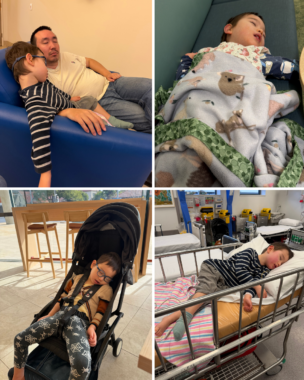
Sleep was a precious commodity for Joelene Wand’s family when her son, Jude, was recently hospitalized. (Photos by Joelene Wand)
The final lesson we learned was that life outside the hospital keeps moving, and rest doesn’t begin at discharge. During our hospital stay, we were answering work calls, rearranging our week, updating family members, and making sure everyone was fed. When we returned home, we cleared our weekend and canceled therapy and swimming lessons so that we could unpack hospital bags, tackle laundry, and simply enjoy sleeping in our own beds again.
Even during the longest days, we still looked for moments of joy. We walked outside the ward whenever we could, even if it was raining. One of the sweetest moments was watching Jude bounce up and down with excitement while FaceTiming his grandpa, a reminder that there was still room for happiness, even in the hospital.
Looking back, one thought stands out above everything else: Parenting a child who is nonverbal reminds us every day that communication is so much more than words. Sometimes it’s simply noticing little things that have changed and the instinct that tells you, “This isn’t my child.”
We were lucky that, this time, those small clues led us to the answers Jude couldn’t tell us in words.
Note: Angelman Syndrome News is strictly a news and information website about the disease. It does not provide medical advice, diagnosis, or treatment. This content is not intended to be a substitute for professional medical advice, diagnosis, or treatment. Always seek the advice of your physician or other qualified health provider with any questions you may have regarding a medical condition. Never disregard professional medical advice or delay in seeking it because of something you have read on this website. The opinions expressed in this column are not those of Angelman Syndrome News or its parent company, Bionews, and are intended to spark discussion about issues pertaining to Angelman syndrome.

Carrie Cheung
I am proud of you because you did not give up. May the Lord give you strength; you are the Son's angels.