
The joys and challenges of disability equipment for children with Angelman
These tools allow our son to explore the world with dignity
Written by |

Over time, our house has slowly filled with medical equipment for our 3-year-old son, Jude, who lives with Angelman syndrome.
Some of it was readily available from local shops, such as soft-play equipment to practice climbing. Some arrived after protracted funding applications following assessments and equipment trials, causing frustration when the system moved slowly.
Sometimes we borrowed equipment from family members that was gathering dust, like shower chairs, exercise balls, and treadmills. On rare occasions, we bought secondhand equipment or created it ourselves, such as when Jude’s grandmother sewed leg gaiters for him. If we’d waited for funding, Jude would’ve outgrown the opportunity to use them.

The range of equipment people living with Angelman syndrome might use varies and includes feeding tubes, safety beds, and wheelchairs. In the last three years, Jude has used:
- A CPAP machine, between 3 and 8 weeks of age
- A sleep apnea monitor, between 2 and 6 months of age
- Tall ankle shoes and ankle-foot orthotics, from 1 year old
- A standing frame, supportive bath chair, arm-elbow gaiters, and an AAC device, from 1.5 years old
- Curved, left-handed cutlery and a custom bodysuit with boning for extra support, from 2 years old
- A walking frame, from 2.5 years old
- Leg gaiters, from 3 years old
Currently, we’re exploring seating systems to allow Jude to sit safely, such as hi-lo chairs and disability strollers, as he’s outgrowing commercial chairs and strollers but needs extra support in his trunk.
What I didn’t fully anticipate until recently wasn’t just the complexities from securing the equipment, but from actually seeing Jude in it.
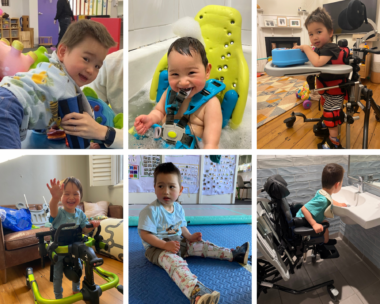
Jude’s equipment over time, from upper left: pushing up on his hands with the assistance of arm-elbow gaiters at 1.5 years old; using a supportive bath seat at 1 year and 9 months old; playing the piano in his standing frame at 2 years and 3 months old. From lower left: waving hello in his walking frame at 2 years and 9 months old; getting ready to stand in his homemade leg gaiters and tall ankle shoes at almost 3 years old; trialing a hi-lo chair and accessing a sink on his own for the first time at 3 years and 3 months old. (Photos by Joelene Wand)
Firstly, it can feel confronting. The disability equipment Jude uses makes his gross motor challenges visible in a way that is hard to ignore, and I wish movement came easier for him.
Yet, at the same time, there is relief that the equipment exists at all. Jude’s safety is paramount, and knowing that he was secure in a supportive bath chair reassured us. Seeing him access a sink on his own for the first time while seated in a hi-lo chair, knowing I might one day no longer need to hold him up to the tap or wash his hands with soap in a bowl, was incredible. And it sometimes helps the community understand quickly, without explanation, that Jude has challenges.
There can be frustration, too. AAC devices aren’t designed to be used on a small dining table in a restaurant. I’m also more aware that members of the community look at Jude differently once his equipment is visible, and I worry that Jude notices these stares as well.
Finally, there’s immense moments of pride. I’ll never forget the moment Jude fed himself with a fork specifically designed with his fine motor challenges in mind. He has also progressed so far with stepping in his walking frame. He didn’t move in it for the first five months, then started bunny-hopping backward in September 2025. Last January, he started propelling himself forward, and he’s now chasing us around the house.
The equipment Jude uses every day can be bulky, heavy, and time-consuming to help him into. It can clutter up the house or take up the entire boot space of our car. And sometimes, it was hard-fought for. But these are the tools he needs to explore the world, giving him the dignity to move, sit, play, and participate more safely and independently.
Note: Angelman Syndrome News is strictly a news and information website about the disease. It does not provide medical advice, diagnosis, or treatment. This content is not intended to be a substitute for professional medical advice, diagnosis, or treatment. Always seek the advice of your physician or other qualified health provider with any questions you may have regarding a medical condition. Never disregard professional medical advice or delay in seeking it because of something you have read on this website. The opinions expressed in this column are not those of Angelman Syndrome News or its parent company, Bionews, and are intended to spark discussion about issues pertaining to Angelman syndrome.



Leave a comment
Fill in the required fields to post. Your email address will not be published.