
Traveling with a child with Angelman syndrome is easier in the early years
As our 3-year-old grows, the way we travel will continue to change
Written by |

After my son, Jude, was diagnosed with Angelman syndrome at 16 months old, I kept hearing the same comment from other seasoned Angelman parents: “Traveling is so much easier when they’re younger.”
At the time, I was skeptical. But now that Jude is 3 and has experienced short- and long-haul flights and road trips, I’m beginning to understand what they meant.
Traveling with a child with Angelman syndrome is never “easy.” It requires planning and a healthy tolerance for unpredictability. But in these early years, there is a particular kind of ease — one rooted in physical capability, social grace, and simpler logistics.

Despite Jude’s hypotonia (low muscle tone), he’s remarkably strong. Still, for now, my husband and I are stronger, and we can physically manage most situations on our own. Jude’s forceful kicks and impressive grip strength are harmless at home, but can be challenging in tight spaces, like on planes, trains, or buses. When he enthusiastically reaches forward to grab the hair of the passenger in front of us or kicks their seat in what feels to him like joyful exploration, I can still gently but firmly redirect him.
We can lift Jude in and out of seats or carry him up and down stairs, which gives us the freedom to choose the quicker route rather than the accessible one. When unfamiliar environments overwhelm him, being carried by us often provides him instant reassurance and regulation.
During these early years, the equipment and logistics involved in travel are also still relatively manageable. Jude fits into a stroller that can be stored overhead, whereas a wheelchair would need to be checked in, increasing the risk of damage during transit. We rarely need bathroom adaptations because we can lift him in and out of baths or onto toilets without additional support.
Evolving needs
That said, we’ve already noticed how the packing list and the mental load of traveling have grown over time. We now need to ensure we bring sufficient seizure and sleep medications as well as fluid thickeners (Jude has dysphagia) in case our luggage gets lost.
Our accommodation needs have also increased. Ideally, the place we stay is step-free, has a washing machine to keep up with the copious laundry that comes with Jude’s drooling and messy eating, and is close to a hospital. Travel insurance while we’re overseas is now essential.
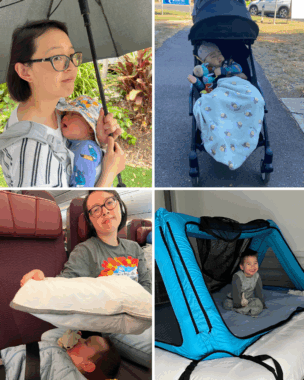
Jude’s sleep during travel has evolved over the years. Clockwise from top left: Jude naps in a carrier at 11 months old; Jude naps in a stroller at 16 months old; Jude sits in his safety travel bed at 3 years old; Jude sleeps on a red-eye flight at 2 years old. (Courtesy of Joelene Wand)
Sleep, too, has become more nuanced. When Jude was younger, he could nap in a stroller or carrier, and hotel travel cots meant one less bulky item to carry. But now, Jude sleeps in a safety travel bed — another piece of equipment to pack, and one that requires a full-sized adult bed to attach to.
But one of the most understated yet significant factors of traveling during the early years is social expectation. The world expects toddlers and young children to be unpredictable, which reduces the emotional load of parenting a child with Angelman syndrome in public. Jude’s uncontrollable laughter, his rocking against chairs, or his sudden impulse to grab any object within reach are often brushed off as age-appropriate behavior. Emotional swings during long waits are met with empathy rather than judgment.
As Jude grows, the way we travel will continue to change. It will require more planning, more equipment, and more support. Lifting may give way to hoists or shared transfers. Plane seating may involve bulkhead rows or careful positioning of caregivers. Accessibility will matter more, and spontaneity will look different. Cruises, which often offer more accessible bathrooms than planes, suddenly seem more appealing.
But different doesn’t mean worse, and it certainly doesn’t mean impossible. We will keep traveling because seeing Jude explore the world is deeply fulfilling. It reminds my husband and me that our family’s world involves more than therapy rooms, and while the ease of the early years may fade, our travels won’t come to an end.
Note: Angelman Syndrome News is strictly a news and information website about the disease. It does not provide medical advice, diagnosis, or treatment. This content is not intended to be a substitute for professional medical advice, diagnosis, or treatment. Always seek the advice of your physician or other qualified health provider with any questions you may have regarding a medical condition. Never disregard professional medical advice or delay in seeking it because of something you have read on this website. The opinions expressed in this column are not those of Angelman Syndrome News or its parent company, Bionews, and are intended to spark discussion about issues pertaining to Angelman syndrome.




Lilly
You are Amazing!!
Thank you for being who you are and for writing and sharing.
Angelman's is watching your Angel teach us that inclusion is deserved.
And parents like yourselves are God's Angels.
These children are Magical.
My Angel Grandson is my life as is yours to you.
God bless you and your family