
Angelman syndrome has shaped how we celebrate our son’s birthday
This year's birthday looked much different from last year's
Written by |
Every now and then, I’m reminded that life for my 3-year-old son, Jude, who lives with Angelman syndrome, has unfolded differently from what I imagined.
In Jude’s swimming class, I watch his peers advance to higher levels while he stays in the beginner group, as he can’t yet be in a pool without one-on-one support. Toddlers at the park run freely while we help Jude into and out of every piece of playground equipment, as he can’t yet walk. Curious children ask me when Jude, who’s nonverbal, will learn to talk while we model augmentative and alternative communication on his device.
Most of the time, these moments don’t sting, and I move on with my day. But as Jude’s birthday approached this year, the differences felt heavier.

Leaning into celebration
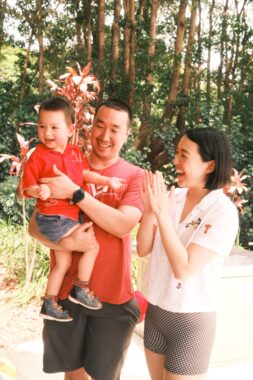
Tom and Joelene Wand celebrate their son Jude’s third birthday. (Photo by Johnston Lee)
When Jude was younger, the gap between him and his peers was noticeable, but it felt small. They were all still learning to walk and talk. But each year, that gap stretches wider and becomes harder to ignore. Birthdays are markers of time and progress. They’re celebrations, but they also quietly remind me that Jude is growing older, which brings new questions and uncertainties.
On the day Jude turned 2 in December 2024, eight months after his diagnosis, I was miserable. We skipped the party, balloons, and cake. We were still reeling, trying to understand a new world of therapies, medical jargon, and reshaped expectations. It felt like there was nothing to celebrate.
But this year feels different. I’m still grieving, but I’ve adopted a gentler kind of acceptance — one rooted in seeing who Jude truly is, not who I thought he would be. His joys, quirks, and strengths are now unmistakable.
It has been a hard year. Jude had his first seizure. He fractured his arm. He spent hundreds of hours in therapy. Yet he also blossomed. He’s beginning to engage with his communication device. He’s having success with toilet timing. He’s feeding himself with a preloaded fork. He’s climbing, crawling, and standing with confidence that I couldn’t have imagined a year ago. And he does it all with a smile and a persistence that humbles me.
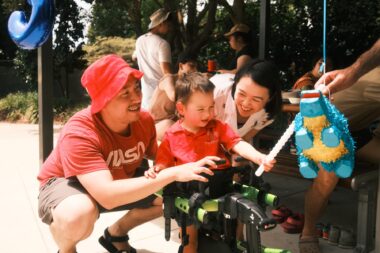
Tom and Joelene Wand watch as their son, Jude, hits a piñata at his birthday celebration. (Photo by Johnston Lee)
So for Jude’s third birthday, we leaned fully into who he is. We held a birthday party at an inclusive splash park, where he wandered around in his walking frame. We had activities that Jude could participate in, such as hitting a piñata, playing with bubbles, and using water guns. Rather than a cake, we had mini cupcakes, which Jude could easily grab and reach. And instead of answering the impossible question of what gift to buy, we invited our family and friends to donate to Angelman-specific charities in Jude’s honor. It felt like a meaningful way to celebrate Jude and give back to the community that lifts him up.
But the best moment was something small. As we arrived at the splash park a month before his birthday, Jude started giggling — the first time he’d ever reacted to a place he knew. We had already chosen it for his party, but his pure, delighted recognition affirmed that we really do know our child, more deeply than we give ourselves credit for.
This year, we’re not just celebrating Jude turning 3. We’re celebrating everything he’s achieved, everything he’s fought for, and everything he’s taught us about joy, patience, and resilience. But we’re also celebrating how far we have come, too — not away from grief, but toward a broader, deeper love that holds both the hard and the hopeful.
Note: Angelman Syndrome News is strictly a news and information website about the disease. It does not provide medical advice, diagnosis, or treatment. This content is not intended to be a substitute for professional medical advice, diagnosis, or treatment. Always seek the advice of your physician or other qualified health provider with any questions you may have regarding a medical condition. Never disregard professional medical advice or delay in seeking it because of something you have read on this website. The opinions expressed in this column are not those of Angelman Syndrome News or its parent company, Bionews, and are intended to spark discussion about issues pertaining to Angelman syndrome.


Phyllis Gallone
My daughter was diagnosed at almost 48! In the early years, nothing was quite known about AS. New genetic testing became available and her primary had it done last year. She has the spontaneous mutation. No other disability quite mimicked hers and we felt isolated all of those years. Now knowing, I feel like we missed a lot but we did ok on our own. She has some speech, and walks and fortunately did not take seizures. She no longer can come down the steps and scoots down so we are limited to places we go. I never had a talking board but she learned some Total Communications (functional signing) which helped with the frustration. The potty sign was the best and she still uses it. It's been a long road but a fulfilling road and we are still open to new things to learn and explore. We are devoted to her and she has taught us so much as a family. Her brothers adore her and she adores them. She loves our pets and halloween stores and of course Santa. Her giggles are the best! I always wonder how things would have been for us to just know sooner. I cannot change that so we just have to move on as we did and do our very best.